
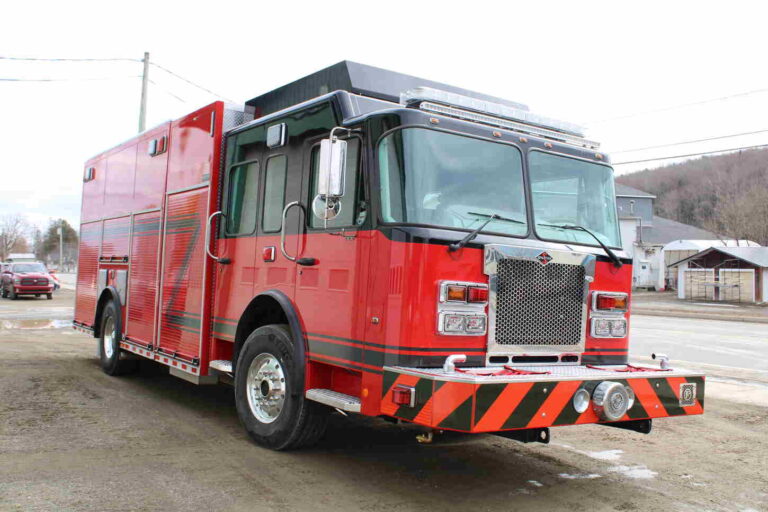
At Metalfab, fire truck design is never about looks alone or checking boxes on a spec sheet. Every design decision is guided by one core question: how does this protect the crew who rely on the apparatus on every call?
The work of a firefighter is unpredictable and takes place in high-pressure environments. Long shifts, extreme heat or cold, heavy traffic, and fast-changing situations are part of the job. A thoughtfully designed fire truck helps reduce risks by minimizing fatigue, improving awareness, lowering the chance of injury, and ensuring systems perform reliably when it matters most.
Good design does not happen by accident. It requires a deep understanding of how firefighters move, communicate, access equipment, and operate under real-world conditions. Below, we discuss six key ways fire truck design directly impacts crew safety.
1. Equipment Storage and Securement
Equipment storage plays a critical role in both safety and efficiency. Tools that are poorly secured can shift or become dangerous projectiles during sudden stops, sharp turns, or collisions.
Well-designed storage systems keep equipment firmly secured during transport while remaining easy to access on scene. Features such as ergonomic mounting heights, slide-out trays, and clearly organized compartments reduce unnecessary climbing, reaching, and heavy lifting. This lowers the risk of strains, slips, and falls.
When storage is designed with real workflows in mind, crews can move faster and safer without putting added stress on their bodies.
2. Accessibility and Egress
Quick and safe entry and exit from the apparatus is essential during emergency responses. Design choices that improve accessibility help reduce slips, trips, and falls while also supporting faster response times.
Steps, handrails, grab points, and door placements should align with natural movement, even when firefighters are wearing full PPE. Proper lighting around entry and exit points is equally important, especially in low-light or nighttime conditions.
Thoughtful accessibility design allows firefighters to get in and out of the vehicle confidently, even in chaotic or hazardous environments.
3. Crashworthiness
Fire apparatus operate in conditions that naturally carry higher risk, including emergency driving, higher speeds, and unpredictable traffic. For this reason, crashworthiness is one of the most critical aspects of fire truck design.
A crashworthy cab includes reinforced structural components, engineered impact zones, and restraint systems designed specifically for emergency vehicles. Secure seating mounts, high-quality airbags, and reinforced cab construction help absorb impact forces and reduce injury severity in the event of a collision.
Designing for crashworthiness recognizes the realities of emergency response and helps ensure crews are protected if the unexpected happens.
4. Ergonomics
Ergonomics is foundational to firefighter safety, especially during long shifts and repeated calls. Poor ergonomics contribute to fatigue, muscle strain, and slower reaction times, all of which increase risk both on the road and on scene.
A well-designed cab supports natural posture and movement. Seating should accommodate turnout gear and SCBA while still providing proper support. Controls and displays should be positioned for easy reach and clear visibility, reducing awkward movements and unnecessary distractions.
When ergonomic principles are applied correctly, crews stay more alert, comfortable, and physically capable throughout their shift, directly improving safety and performance.
5. Visibility
Clear visibility is essential for safe driving and effective scene operations. Fire trucks must navigate busy roads, tight spaces, and crowded accident scenes where blind spots can quickly become hazards.
Good design improves visibility through large windows, properly positioned mirrors, and integrated camera systems that reduce blind spots and enhance spatial awareness. These features help drivers maneuver more safely and lower the risk of collisions with vehicles, pedestrians, or obstacles.
Visibility also includes how well the apparatus is seen by others. Exterior lighting systems improve awareness for motorists and pedestrians, helping create safer working zones around the vehicle during emergency responses.
6. Communication Systems
Clear communication is the backbone of effective emergency response, and fire truck design must support reliable information flow in high-stress, high-noise environments. Crews need to communicate clearly with one another, command staff, and other responding agencies while managing multiple tasks at once.
Modern apparatus design should integrate dependable two-way radios and in-cab intercom systems that remain audible over sirens, traffic, and equipment noise. These tools allow crews to coordinate while the vehicle is in motion or while wearing protective gear, reducing the need for distraction or unnecessary movement inside the cab.
Many fire trucks now also support data-sharing tools such as mobile data terminals or integrated displays that provide access to dispatch details, mapping, and pre-incident information. These systems should be positioned so that critical information is easy to access without pulling attention away from driving or scene operations.
When communication systems are thoughtfully integrated into the overall design, crews can coordinate more efficiently, reduce misunderstandings, and make faster, safer decisions while on scene.
Designing Safer and Smarter with Metalfab
At Metalfab, safety is not something added at the end of the build. It is a guiding principle throughout the entire design and manufacturing process. We understand the real conditions fire departments face and design apparatus that support crews in demanding, high-risk environments.
From ergonomic cab layouts and advanced restraint systems to reinforced structures, optimized visibility, intelligent storage, and modern communication technology, every Metalfab fire truck is built with crew safety as a top priority.
Choosing Metalfab means choosing a partner committed to helping your department respond with confidence and return safely from every call.
If you are ready to begin a collaborative design process and build a custom fire truck tailored to your department’s needs, call 800-561-0012 or contact us to start the conversation.